Showing posts with label op-amp circuit. Show all posts

The difference between difference amplifier and instrumentation amplifier

Dear all hands

Some time we need more powerfull amplifier, specially when we deal with transducer that its output is very small such of thermocouple. And the answer Is instrumentation amplifier.
Why difference amplifier did not adequate on such application? The difference amplifer is satisfactory for low impedance source, buts its input impedance is too low for high output impedance sensor. Furthermore , If the input signal very low level and inckude signal noise, the difference amplifier is unable to extract a satisfactory difference signal. The solution is not difference amplifier but instrumentation amplifier.
Instrumentation amplifier has the following characteristic :
a. Instrumentation amplifier has Very high input impedance
b. Large CMMR: CMMR is the ratio of the difference mode gain to the common mode gain. The difference mode gain is the amplification factor for the difference between the input signals, and the common mode gain is the amplification factor for the average of the input signal. For an ideal instrumentation amplifier and difference amplifier , the common mode gain is zero, implying an infinite CMMR. But sure the ideal instrumentation amplifier isnot exist.
c. Instrumentation amplifier has capability to amplify low level signal in noisy environment (due to high CMMR)
d. Instrumentation amplifier has consisten bandwidth over a large range of gain.
Instrumentation amplifier are commercially available as monolithic IC( ex. AD 5234, AD624 or LM 623). In these instrumentation amplifier ICs , a single external resistor is used to set gain.
But theorycally, we can made an instrumentation amplifier using op-amp. There are many instrumentation amplifier circuit design , following figure show an instrumentation amplifier circuit use three op-amp.
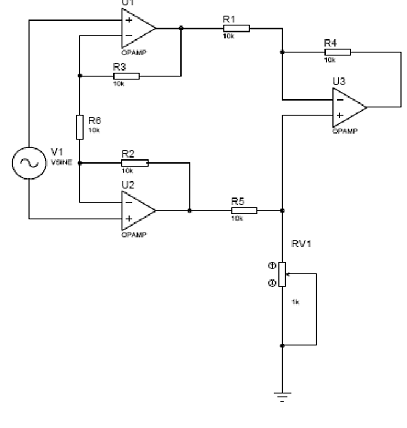
Practical DC Differential Amplifier For Sensor Amplifiers Circuit with Op-Am

Practical DC Differential Amplifier For Sensor Amplifiers Circuit with Op-Am

Dear all hand

When we want to supresse interference in our practical sensor amplifier its mean we must use a pratical differential amplifier for sensor amplifier that has ability to suppress interference, and the answer is differential amplifer.

In many system the input leads pickup 60hz from the power line feeds that permeate all electrical building. In single ended practical sensor amplifier , the 60 hz interfering signal treated as valid input.

But in practical differential amplifier the two leads affected equally by the field so they present equal strength signal to the (-) and (+) input. In differential amplifier , just only the difference of two inputs treated as desired signal.

There are two basic configuration of differential amplifier for sensor:

  1. The DC differential amplifier circuit for sensor signal amplifier
  2. Instrumentation amplifier

Below is a figure depicted practical differential amplifier circuit for practical sensor amplifier:


This practical differential amplifier for sensor need to ensure that two input reistance is in balance (R1 = R2) and also feedback resistor in balance (R4=R3), if this two condition is satisfied output will follow this equation : Vout = (Vin+-Vin-) x R3/R1.

Limitation of this practical dc differential amplifier include a reatively low maximum ain and a low input impedance (set by R1 and R2). These problem are overcome in more advanced practical differential amplifier called the instrumentation amplifier.